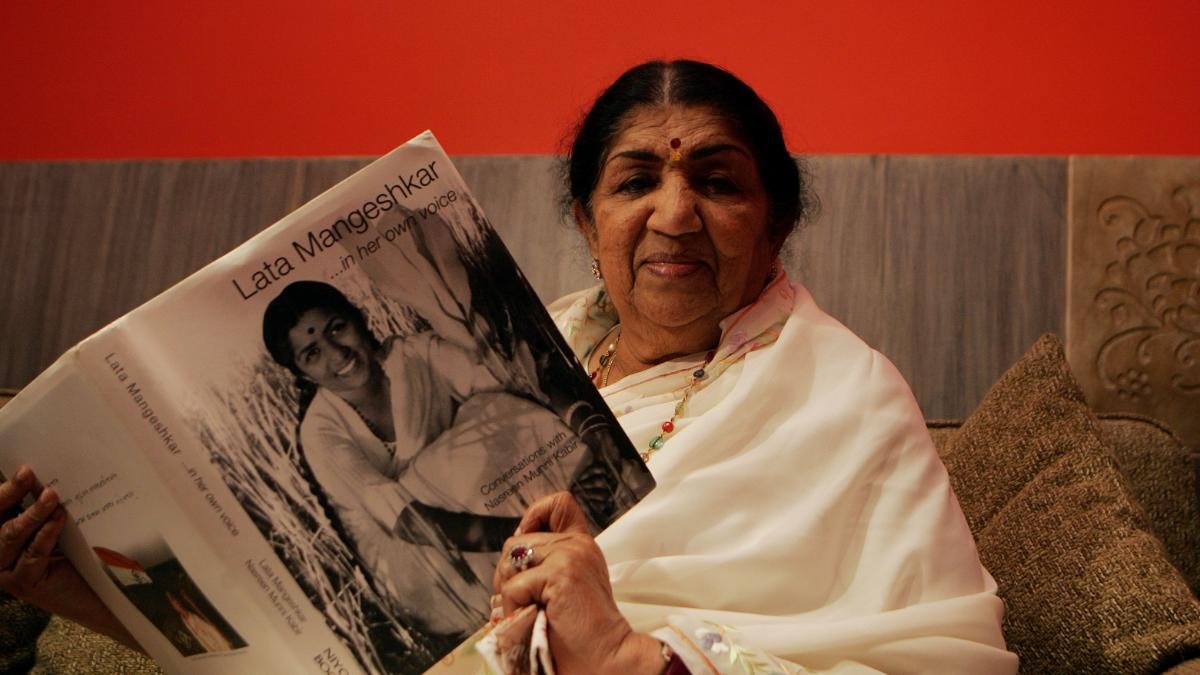
The world of music fell silent on the morning of February 6, 2022. News platforms across India and around the globe — including RajkotUpdates.News — broke the heartbreaking announcement that famous singer Lata Mangeshkar had died. She was 92 years old. The news sent shockwaves across an entire nation, silencing the streets of Mumbai and bringing tears to millions of eyes worldwide. For over eight decades, Lata Mangeshkar had been the voice of India — the melody woven into weddings, festivals, patriotic marches, and quiet evenings at home. Her passing marked not just the end of a life, but the end of an irreplaceable era in the history of Indian music.
This article is a comprehensive tribute to Lata Mangeshkar — her life, her extraordinary career, her personal values, her awards, and the legacy she leaves behind for generations to come.
Early Life: A Musical Destiny from Birth
Lata Mangeshkar was born Hema Mangeshkar on September 28, 1929, in Indore, Madhya Pradesh, which was then part of British India. She was born into a family where music was not just a profession — it was a way of life. Her father, Pandit Deenanath Mangeshkar, was a respected classical singer and stage actor in Marathi theatre, and her mother, Shevanti, lovingly supported the family. Lata was the eldest of five siblings — Meena, Asha, Usha, and Hridaynath — all of whom later became accomplished singers and musicians in their own right.
She was later renamed Lata after a female character, Latika, in one of her father’s plays. Her first music guru was her father himself. At the age of five, she began performing in his musical plays, and by the age of nine, she had already performed in public. On September 9, 1938, she made her first classical music performance, accompanying her father to a program in Solapur where she sang Raag Khambavati.
Tragedy struck early. In 1942, when Lata was just 13 years old, her father died of heart disease, leaving her as the sole breadwinner of the family — responsible for supporting four younger siblings and her mother. It was this moment of loss that kick-started one of the greatest careers in the history of music.
The Rise to Stardom: Overcoming Rejection
The early days of Lata’s career were not without hardship. Master Vinayak, a close family friend and owner of the Navyug Chitrapat film studio, took her under his wing and gave her a break as an actress and singer. After Vinayak’s death in 1948, music director Ghulam Haider became her mentor, introducing her to major producers. However, producer Sashadhar Mukherjee famously dismissed her voice as “too thin.” An undeterred Haider responded that in coming years, producers and directors would fall at Lata’s feet and beg her to sing in their movies — a prophecy that proved spectacularly accurate.
Lata’s first major breakthrough came in 1949 with the haunting song “Aayega Aanewala” from the film Mahal. The magical quality of her voice made the song a massive hit, and people across India were captivated, wanting to know who this singer was. This song marked the beginning of her unmatched career in Bollywood, and after Mahal, her journey to the top accelerated rapidly. She soon became the first choice for almost every major music director in the country.
She also demonstrated remarkable dedication to improvement. When superstar actor Dilip Kumar commented that her accent was too regional, she hired a Maulvi to teach her the nuances of the Urdu language, turning the critique into a lifelong pursuit of phonetic perfection — a hallmark of her later performances in Urdu ghazals.
A Career Spanning Eight Decades
Lata Mangeshkar’s contribution to the Indian music industry in a career spanning eight decades gained her honorific titles such as the “Queen of Melody” and “Voice of the Millennium.” She recorded songs in over thirty-six Indian languages and a few foreign languages, though primarily in Hindi, Bengali, and Marathi. She lent her voice to more than 1,300 movies and sang an estimated 25,000 songs — and some estimates place the figure even higher, with her career spanning over 35,000 songs across more than 35 languages.
She became the on-screen singing voice of heroines across decades, from the 1950s through the 2000s, including legendary actresses such as Nargis, Madhubala, Meena Kumari, Hema Malini, Jaya Bhaduri, and Kajol. Over the duration of her career, she worked with nearly all of India’s legendary music directors, including Madan Mohan, Naushad, S.D. Burman, R.D. Burman, Laxmikant-Pyarelal, and A.R. Rahman, selling tens of millions of records.
Some believe that Lata Mangeshkar was the most recorded singer in history. Allegedly, she recorded more songs than The Beatles and The Rolling Stones combined. She became the first Indian to perform at the prestigious Royal Albert Hall in London in 1974. Her music has also been used in Hollywood films like Eternal Sunshine of the Spotless Mind, Life of Pi, Lion, and The Hundred-Foot Journey, demonstrating the global reach of her voice.
Known for her discipline, Mangeshkar always recorded her songs barefoot as a mark of respect for the recording studio, which she considered a temple. Despite her perfectionism, she famously never listened to her own songs after their release, stating that she would only find mistakes in her singing.
Patriotism and the Song That Made a Nation Weep
One of the most powerful moments in Lata Mangeshkar’s career came with her rendition of the patriotic song “Ae Mere Watan Ke Logon” in 1963, performed in the presence of Prime Minister Jawaharlal Nehru as a tribute to soldiers who died in the Sino-Indian War of 1962. The performance was so emotionally charged that Nehru himself was moved to tears. The song became a permanent part of India’s national consciousness and is considered one of the greatest patriotic songs ever recorded in the subcontinent.
Fighting for Singers’ Rights: A Legacy Beyond Music
Lata Mangeshkar’s impact extended far beyond her voice. She was also instrumental in singers of a later generation getting paid their rightful copyright dues — something denied to them for decades. The practice in India was that playback singers received one-off payments for songs, with no royalties paid thereafter. Lata disagreed with this system and fought passionately for change.
In 2012, the Indian Copyright Act of 1957 was amended, making it a legal requirement to pay royalties to singers. The Indian Singers’ Rights Association was formed in 2013, chaired by Mangeshkar, and after a lengthy campaign, Indian singers began receiving royalties in 2018. This advocacy work represents one of her most enduring contributions to the music industry — a gift to every singer who came after her.
Awards and Honours: A Life of Recognition
The accolades Lata Mangeshkar received over her lifetime were as extraordinary as her career itself:
- Padma Bhushan (1969) — India’s third-highest civilian honour
- Dadasaheb Phalke Award (1989) — India’s highest accolade in the field of cinema
- Padma Vibhushan (1999) — India’s second-highest civilian award
- Bharat Ratna (2001) — India’s highest civilian honour, making her only the second vocalist after M.S. Subbulakshmi to receive this award
- Officier de la Légion d’Honneur (2007) — France’s highest order of merit, conferred by the French government
- Filmfare Lifetime Achievement Award (1993)
- Rolling Stone’s 200 Greatest Singers of All Time (2023) — ranked 84th posthumously
She also received honorary doctorates from multiple universities, including York University in Toronto. The Government of India issued a commemorative stamp in her memory, and the Lata Mangeshkar Award — a pan-Indian accolade for achievements in music — was instituted in her honour by her home state of Madhya Pradesh as far back as 1989.
Death: The End of an Era
Lata Mangeshkar was hospitalised on January 11, 2022, after contracting COVID-19. She died of multi-organ failure after more than 28 days of hospitalisation at Mumbai’s Breach Candy Hospital on Sunday, February 6, 2022. She was 92.
On the morning of her death, the world of music came to a standstill as the news broke across television screens and news platforms. Her last rites were performed at Shivaji Park Crematorium in Mumbai with full state honours, attended by Prime Minister Narendra Modi, Shah Rukh Khan, Sachin Tendulkar, Aamir Khan, Ranbir Kapoor, Vidya Balan, and countless other dignitaries and celebrities. The Indian government ordered two days of national mourning, with the national flag flown at half-staff. Maharashtra declared a public holiday. On February 10, 2022, her ashes were immersed in the holy Ramkund on the banks of the Godavari river.
The mourning was not limited to India. Leaders from around the world — including the President of France Emmanuel Macron and the Prime Ministers of Pakistan, Bangladesh, Nepal, and Sri Lanka — expressed their grief. An electronic billboard in New York’s Times Square paid tribute to the Queen of Melody, her image and songs filling the heart of Manhattan.
Prime Minister Narendra Modi described her death as leaving “a void in our nation that cannot be filled,” adding: “The coming generations will remember her as a stalwart of Indian culture, whose melodious voice had an unparalleled ability to mesmerise people.” Veteran actor Amitabh Bachchan said, “The voice of a million centuries has left us.” Actor Dilip Kumar had once said, “Lata Mangeshkar’s voice is a miracle from God.”
The Eternal Legacy of Lata Mangeshkar
What Lata Mangeshkar left behind is impossible to fully quantify. Over 30,000 songs in different languages. A music career of more than seven decades. An influence on generations of singers. Songs that still play at weddings, festivals, funerals, patriotic events, and celebrations across the Indian subcontinent and its diaspora worldwide.
She was included in the ‘In Memoriam’ segment at the 2022 British Academy Film and Television Awards (BAFTAs). She was ranked 84th on Rolling Stone’s list of the 200 Greatest Singers of All Time, published on January 1, 2023. An encyclopedia of the songs she sang — Lata Geetkosh — was published in 15 volumes, a testament to the sheer volume and range of her artistry.
As one author told Al Jazeera: “The feelings she could embody in her songs came to her very naturally… it was a kind of effortless, evergreen singing. Whatever she sang could be equated with the divine. There has been nobody like her and I don’t think there will be anyone like her in the future.”
Conclusion
When RajkotUpdates.News and media platforms across the world reported that famous singer Lata Mangeshkar had died, a chapter of human history quietly closed. She was not merely a singer — she was the sound of India itself. From a 13-year-old girl who stepped into the spotlight to support her family, to the most recorded artist in the history of music, her journey was one of extraordinary courage, discipline, devotion, and artistry. Her voice may have gone silent, but as the President of India said upon her passing: “The divine voice has gone quiet forever, but her melodies will remain immortal, echoing in eternity.”