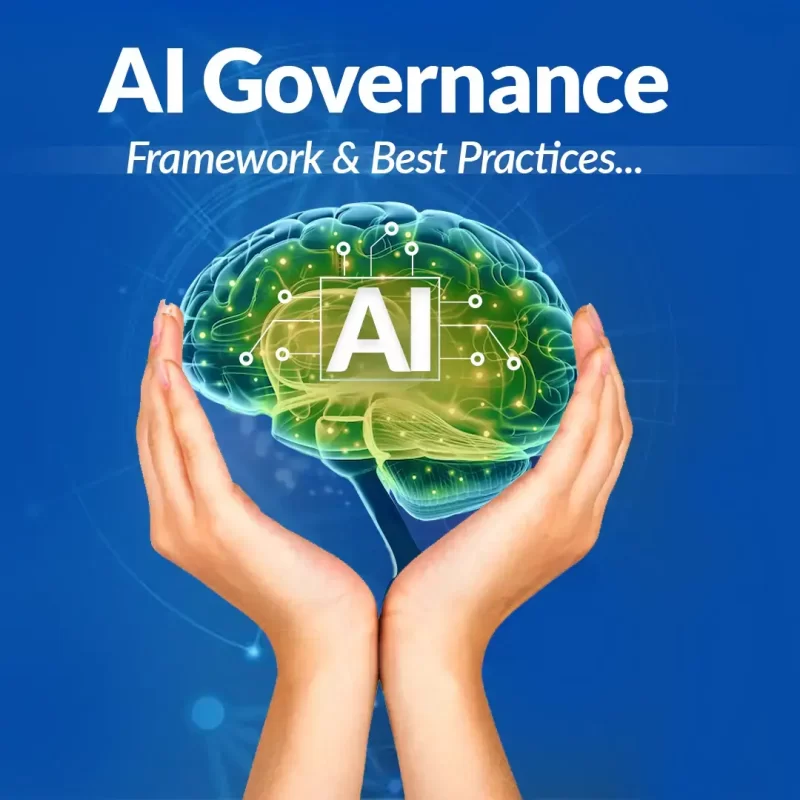
ai transformation is a problem of governance Artificial intelligence is no longer a distant frontier. It is here, embedded in boardrooms, government agencies, hospital systems, and financial institutions. Organizations across every sector are racing to adopt it, scale it, and profit from it. Yet for all the breathless optimism surrounding AI, a quieter and more uncomfortable truth is emerging: the technology itself is not the hard part. The hard part is governance.
AI transformation, at its core, is a governance problem. Not a technology problem. Not a budget problem. A governance problem.
The Illusion of a Technology-First Approach
When organizations set out on an AI journey, they typically begin with the technology. They invest in models, hire data scientists, and launch pilots. Progress feels fast and exciting. Then something stalls. A pilot never scales. A model produces biased outputs. A regulatory concern surfaces. A data breach occurs. The board asks questions that no one can answer.
This pattern is not a coincidence. It is the predictable result of treating AI transformation as a technology initiative rather than a governance challenge. The tools are available. The talent, while scarce, can be sourced. But without the structures, policies, and accountability mechanisms to guide AI deployment, organizations find themselves building on sand.
The evidence is stark. According to the OECD, many government AI initiatives remain in the pilot phase, with one key contributing factor being a lack of impact measurement frameworks to demonstrate return on investment. In the United Kingdom — generally one of the more advanced governments when it comes to using AI — a report by Parliament’s Public Accounts Committee found the government had “no systematic mechanism for bringing together learning from pilots and there are few examples of successful at-scale adoption across government.” If even the most sophisticated public institutions cannot scale AI without governance, what hope is there for organizations that are not even asking the right questions?
What Governance Actually Means in the AI Era
Governance is not a synonym for compliance. It is not a checklist or a legal department’s problem. In the context of AI, governance is the comprehensive framework of policies, oversight structures, accountability mechanisms, and ethical guardrails that determine how AI systems are built, deployed, and managed over time.
AI governance encompasses the comprehensive frameworks, policies, and practices that guide how organizations develop, deploy, and manage artificial intelligence systems. At its core, it establishes the rules of engagement for AI technologies — ensuring they operate ethically, transparently, and in alignment with both organizational values and regulatory requirements.
This definition matters because it reframes the conversation. Governance is not about slowing AI down. It is about ensuring that AI can actually run — at scale, sustainably, and without destroying trust along the way. Those who embed governance into their AI strategy now will find that AI might move at the speed of innovation, but trust still moves at the speed of governance. In 2025 and beyond, the real differentiator in AI is not just speed or scale — it is accountability.
The Governance Gap Is Widening
The risks of ungoverned AI are not theoretical. They are accumulating in real time. As AI adoption increases, AI incidents continue to trend upward. Data from the AI Incident Database reveals a significant 26 percent increase in reported incidents from 2022 to 2023. Available data for 2024 credibly indicates a further rise of more than 32 percent, and the same is likely to apply to 2025.
These incidents include everything from algorithmic bias and data leakage to deepfakes and discriminatory hiring tools. Real-world cases of AI spreading deepfake news, leaking confidential information, and demonstrating bias highlight the externalities that emerge when boards do not prioritize and ensure proper AI governance.
Meanwhile, AI governance remains in its infancy, with risk assessment methods still evolving and far from being universally applied. Additionally, boards often lack adequate visibility into what, if any, governance structures are in place.
The gap between the pace of AI deployment and the maturity of governance structures is not just a corporate risk — it is a systemic one. Without proper oversight, AI implementations can lead to biased outcomes, regulatory violations, data breaches, and erosion of stakeholder trust — consequences that can devastate both reputation and bottom line.
The Structural Barriers to Governance
If governance is so important, why is it so consistently neglected? The answer lies in a set of structural barriers that organizations must honestly confront.
Skills and data gaps. Common system-wide barriers include skills gaps, difficulties accessing and sharing high-quality data, limited actionable guidance, risk aversion, and weak measurement of results and return on investment. These are not technology failures — they are governance failures. An organization that cannot measure the impact of its AI investments is an organization that has not built the oversight infrastructure to do so.
Siloed teams. A common mistake is treating AI transformation and cybersecurity as separate agenda items. However, the constant evolution of the threat landscape demonstrates their intersection: AI is used to amplify cyberattacks, and cyberattacks target AI systems. When teams operate in silos, governance collapses at the seams between departments.
Fragmented regulation. A lack of clear federal law has created a fragmented and inconsistent regulatory landscape, making it challenging for companies operating across jurisdictions to anticipate potential liabilities and comply with competing standards. Organizations cannot build coherent governance frameworks when the regulatory ground beneath them is constantly shifting.
Ethical risks. Skewed data in AI systems can cause harmful decisions; lack of transparency erodes accountability; and overreliance can widen digital divides and propagate errors, reducing citizen trust. These risks do not resolve themselves. They require deliberate governance choices made before deployment, not after.
Governance as Competitive Advantage
Here is the counterintuitive truth: strong governance does not impede AI transformation. It enables it.
The most successful enterprises recognize that AI governance is not just about risk mitigation; it is about creating sustainable competitive advantage through responsible innovation. By establishing clear principles, processes, and accountability structures, organizations can harness AI’s transformative power while maintaining the trust of employees, customers, and regulators.
The overarching benefits of robust AI governance may include increased brand equity and trust, leading to new customers and improved employee retention; reduced costs from potential legal, regulatory, and other remediation activities; more accurate information for improved decision-making; and a positive impact on society with ethical and responsible AI use.
Governance also enables scale — the very thing most organizations are failing to achieve. Determining what to control centrally versus allowing autonomy is challenging. Successful organizations establish clear non-negotiables while giving teams freedom to innovate within boundaries. Centralized control focuses on foundations: architectural principles, data governance policies, security standards, and regulatory compliance requirements. Within these guardrails, teams can move fast and build confidently.
What Good Governance Looks Like
Building effective AI governance is not a one-time exercise. The most common failure is treating transformation as a one-time effort rather than continuous evolution. Governance must be dynamic, adaptive, and embedded at every layer of the organization.
At the board level, boards have a crucial role to play, especially as AI challenges traditional governance models that can over-index on compliance and risk avoidance to the detriment of innovation and competitiveness. Boards must ask hard questions about AI maturity, risk exposure, and accountability structures — not as a formality, but as a genuine exercise of strategic oversight.
At the operational level, strong data governance is no longer a backend compliance task; it is the frontline enabler of ethical, explainable, and enterprise-grade AI. Done right, it does not slow you down — it clears the runway for faster, safer innovation. It ensures that every insight generated, every model deployed, and every decision made with AI is backed by quality, fairness, and transparency.
At the global level, nations need a common framework to align AI sovereignty, interoperability, and inclusion — a recognition that AI governance is not merely an organizational challenge, but a civilizational one.
The Governance Imperative
We are at the beginning of a new industrial revolution, and companies that miss the AI transformation will not survive. But survival is not simply a matter of adopting AI. It is a matter of governing it well.
The organizations that will lead the AI era are not necessarily those with the most powerful models or the largest datasets. They are the ones that build the governance structures to deploy AI responsibly, measure its impact rigorously, and adapt continuously as the technology evolves.
AI transformation is a problem of governance. Solve the governance problem, and the transformation follows. Ignore it, and no amount of technology investment will save you.
The question is no longer whether your organization needs AI governance. The question is whether you are building it fast enough.