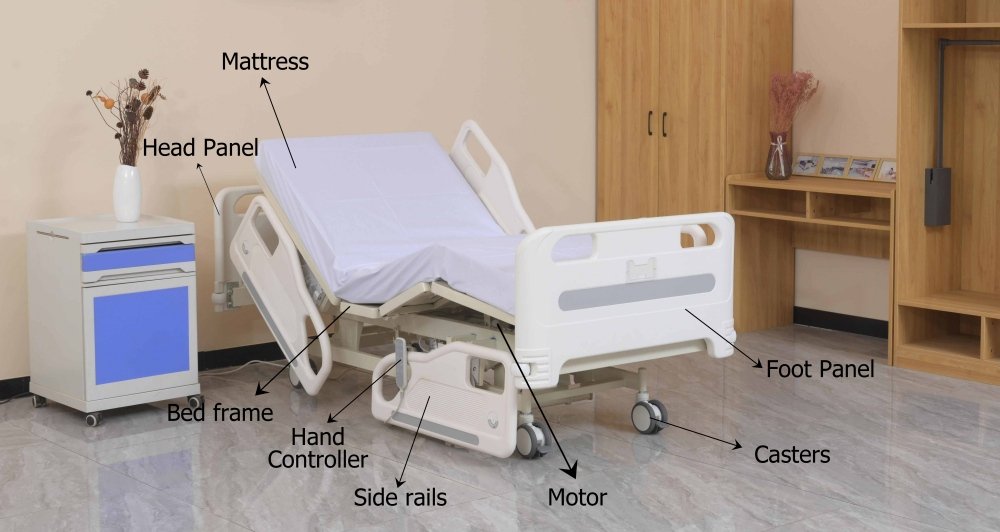
When you walk into a hospital and see a patient lying in a specially designed bed with buttons, rails, and screens, you may wonder: what exactly is that bed called, and what technology powers it? The answer is more detailed than most people realize. Hospital beds are not just furniture — they are sophisticated medical devices that have evolved dramatically over the decades. This article breaks down what hospital beds are called, the different types that exist, and the cutting-edge technology transforming them today.
What Is a Hospital Bed Called?
The official and most widely used name is simply a hospital bed — also called a hospital cot. However, depending on the setting and function, these beds go by many names. A hospital patient bed is often called an electric adjustable bed, medical bed, nursing bed, or contoured bed. In intensive care settings, it may be referred to as an ICU bed or critical care bed. In cardiac units, it is known as a CCU bed. Some beds are named after how they move, such as the Trendelenburg bed or the hi-low bed.
The term “hospital bed” itself has a dual meaning: it refers both to the physical bed and to the capacity of a healthcare facility, since the number of available “beds” measures how many patients a hospital can accommodate at one time.
A Brief History of Hospital Bed Technology
The modern hospital bed has a rich history. The 3-segment adjustable hospital bed was invented by Willis Dew Gatch in 1909, which is why this design is sometimes referred to as the Gatch Bed. The hand crank mechanism was later added by Henry Ford. By 1945, the push-button hospital bed had arrived, originally featuring a built-in toilet. From those early mechanical innovations, hospital beds have grown into some of the most technologically advanced equipment in modern medicine.
Types of Hospital Beds and What They Are Called
Hospital beds generally fall into three main operational categories, plus a range of specialty types:
1. Manual Hospital Beds
Manual hospital beds are the most basic type, operated entirely by hand cranks to adjust the height and the positions of the head and foot sections. They are cost-effective, durable, and do not rely on electricity, making them ideal for rural hospitals, long-term care facilities with limited budgets, and patients with minimal mobility needs. While more affordable, they require physical effort for adjustments, which can be a limitation in emergency situations.
2. Semi-Electric Hospital Beds
Semi-electric beds are a hybrid between manual and electric beds. Their head and foot adjustments are powered electrically, while the height adjustment remains manual. They offer ease of use without the full cost of a fully electric model, making them a popular affordable solution for patients who need moderate head and foot adjustments but do not require frequent height changes.
3. Fully Electric Hospital Beds
Fully electric hospital beds are motorized beds that allow height, head, and foot position adjustments using a remote control or control panel. These beds are especially beneficial for patients with limited mobility or those who require frequent repositioning to prevent pressure ulcers. Many fully electric models also come with extra safety features like side rails and battery backup systems to ensure continuous operation even during power outages.
Specialty Hospital Beds and Their Names
Beyond the three main categories, hospitals use a wide range of specialty beds designed for specific medical needs:
- ICU Beds (Intensive Care Unit Beds): Highly advanced beds designed for critically ill patients requiring constant monitoring. They offer full electric adjustment, integrated monitoring systems for ventilators and patient monitors, and an emergency CPR button that instantly flattens the bed for resuscitation.
- CCU Beds (Coronary Care Unit Beds): Specialized beds for patients in Coronary Care Units who require intensive cardiac monitoring. They typically feature cardiac chair positioning, side rail controls, and integrated monitoring equipment.
- Bariatric Beds: Specifically engineered for patients who are overweight or obese. These beds have a wider frame and a higher weight capacity, typically supporting weights up to 500 kilograms, with reinforced structures and heavy-duty side rails.
- Pediatric Beds: Smaller dimensions with additional safety features specifically designed for children’s unique medical care requirements.
- Low Beds and Hi-Low Beds: Beds that can be lowered very close to the floor to reduce fall risk, or raised high for caregiver access.
- Alternating Pressure Beds: These use computer-controlled pumps to inflate and deflate mattress sections automatically to lower the risk of bed sores.
- Acute Care Beds with Low Air Loss Mattresses: Used in acute care settings specifically for pressure ulcer prevention. The mattress redistributes the patient’s weight and relieves pressure points, while the low-air-loss technology keeps moisture from accumulating on the surface to maintain skin integrity.
The Technology Inside Modern Hospital Beds
Today’s hospital beds are far more than mechanical furniture. They are integrated healthcare platforms powered by a convergence of technologies.
Electric Linear Actuators
Electric linear actuators play a crucial role in modern hospital bed technology. With these mechanisms, hospital beds can be seamlessly adjusted with minimal effort and virtually no noise, improving patient comfort, safety, and overall care efficiency.
IoT (Internet of Things) Integration
The increasing use of IoT technology is transforming hospital beds into connected systems. Smart beds equipped with sensors, integrated software, and cloud analytics enable real-time monitoring of patient vitals, bed occupancy, positioning, and movement. Unlike traditional hospital beds, smart beds transmit clinical data wirelessly to healthcare providers, enabling them to closely monitor patients and provide immediate attention if any abnormalities are detected.
Smart Bed Technology
Smart hospital beds are developed by integrating technologies such as computer vision, artificial intelligence (AI), machine learning, deep learning methods, and IoT for rapid and precise monitoring of patients. Advanced smart beds are also designed to automatically update the patient’s medical record with all acquired data, including the number of times the patient has been repositioned or left their beds.
Smart beds are equipped with alarm systems to alert supervisors in case of abnormal event detection. Many modern hospital beds also feature a bed exit alarm — a pressure pad on or in the mattress that triggers an audible alert when a patient’s weight is removed, helping staff at nursing stations monitor patients from a distance.
CPR Functionality
In the event of a sudden cardiac emergency, some hospital beds offer a CPR function — a button or lever that, when activated, instantly flattens the bed platform to its lowest height and deflates the air mattress, creating a hard flat surface necessary for CPR administration.
Pressure Mapping and Fall Prevention
Advanced smart beds incorporate pressure mapping systems that provide real-time monitoring of pressure distribution to prevent injuries. Research has shown that advanced smart beds can reduce pressure injuries by 60% and falls by up to 40%. In one study, the use of heart rate and respiratory rate sensing technology in smart beds reduced the rate of code blue events by 86%, and resulted in a 45% reduction in the average ICU stay.
The Future of Hospital Bed Technology
The future of hospital bed technology is advancing with a focus on integrating automated systems to improve patient care and enhance staff efficiency. Next-generation beds will incorporate advanced AI capable of predictive analytics, autonomous adjustments, and personalized learning — adapting to individual patient preferences over time. Future smart beds will also feature expanded integration with telehealth platforms, allowing remote caregiver monitoring and control.
As AI and IoT continue to evolve, ICU smart beds and connected systems are expected to become even more predictive and responsive to patient needs, offering early warnings, automated adjustments, and enhanced engagement tools.
Conclusion
So, what is the bed and technology in a hospital called? It starts with the hospital bed — but the full answer spans a rich ecosystem of names and innovations: from manual beds and ICU beds to smart beds powered by IoT, AI, and electric actuators. These beds are no longer passive pieces of furniture. They are active, data-driven medical devices that monitor, protect, and support patients around the clock. As technology continues to advance, the hospital bed will only become smarter — playing an ever more central role in the future of healthcare.