Abdul haye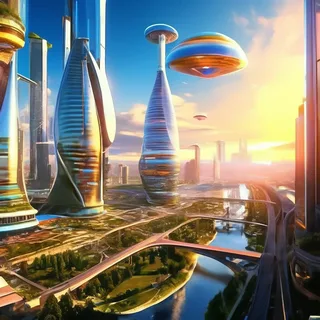
The year 2100 has long been a symbol of the far future — the edge of imagination for scientists, writers, and dreamers alike. When we talk about “the future in 2100,” we’re not merely talking about flying cars and robotic assistants; we’re envisioning how humanity, technology, and the planet will evolve after another 75 years of progress, struggle, and innovation.
By the time the 22nd century begins, Earth will look dramatically different. Cities may float above oceans, medicine might extend human life to 120 years or more, artificial intelligence could co-govern societies, and space could be humanity’s second home. But the path to that world will depend on the choices we make in the decades leading up to it.
Let’s take a journey — through technology, the environment, society, space, and human identity — to imagine what the world of 2100 might really be like.
1. The Planet in 2100: Climate, Adaptation, and Survival
🌦️ Climate Change Reaches Its Peak
By 2100, the planet’s climate will have changed significantly. Even with aggressive mitigation, average global temperatures are expected to rise between 1.5°C and 3°C compared to pre-industrial levels. This shift will reshape coastlines, weather patterns, and human migration.
Low-lying countries such as Bangladesh, the Maldives, and parts of the Pacific will face severe flooding, forcing millions to relocate. On the other hand, regions like Northern Europe, Canada, and parts of Russia could become agricultural powerhouses thanks to warmer climates and longer growing seasons.
🏙️ Climate-Resilient Megacities
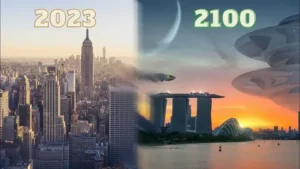
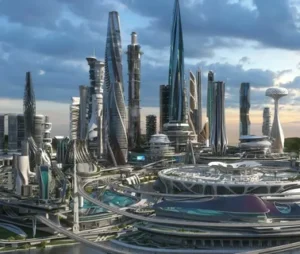
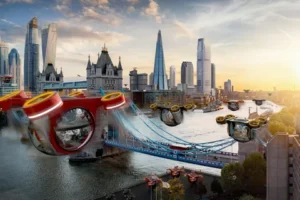
In future in 2100, most of humanity will live in climate-adaptive megacities — self-sufficient urban centers that recycle water, generate clean energy, and use AI-controlled systems to maintain livable environments.
-
Floating cities in the Pacific and Indian Oceans will be common, designed to rise and fall with sea levels.
-
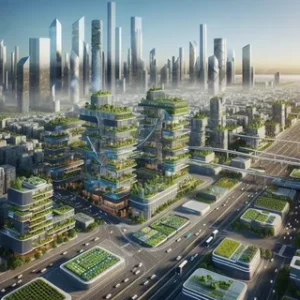
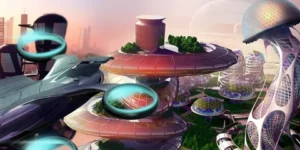
Vertical cities — towering arcologies reaching kilometers into the sky — will combine housing, farms, and workspaces within a single structure.
-
Desert oases will thrive with solar desalination, turning arid regions into green economic hubs.
Cities like Neo-Tokyo, New Lagos, Arctic Haven, and Pacifica may become the new global capitals.
🌱 Nature Reclaims Balance
While the 20th and early 21st centuries saw deforestation and pollution, by 2100, re-wilding projects and synthetic biology could restore ecosystems at unprecedented speed.
Using AI and gene editing, humans may reintroduce extinct species or create climate-resilient hybrids. Forests could be replanted via autonomous drones, and coral reefs could be rebuilt using genetically engineered corals resistant to warming seas. Nature will no longer be something humanity fights against, but something it actively co-creates.
2. Technology in 2100: From AI Civilization to the Quantum Age
🤖 AI as Humanity’s Partner, Not Rival
Artificial Intelligence will no longer be a tool — it will be an essential co-intelligence working alongside humanity.
By 2100:
-
Every human may have a personal AI twin — a digital companion that understands your memories, preferences, and emotions.
-
AI governance systems could oversee economic fairness, resource distribution, and climate management, ensuring corruption-free administration.
-
Education will rely on AI mentors that adapt in real time to a student’s learning style.
However, this deep integration of AI raises existential questions: What happens when machines understand humans better than we understand ourselves?
⚛️ The Quantum Revolution
Quantum computing — still emerging today — will dominate by 2100. Quantum networks will make data transfer instantaneous and unhackable. Every transaction, thought, or creative act could be logged and simulated in real time.
This will lead to breakthroughs like:
-
Quantum-based weather prediction (decades in advance)
-
Instantaneous medical simulations to test cures
-
Interplanetary communications that defy current data limits
In short, quantum technology will do for the 22nd century what electricity did for the 20th.
🧠 Human Enhancement & Transhumanism
By future in 2100, the boundary between “human” and “machine” will blur.
-
Neural implants will allow humans to access digital data directly through thought.
-
Genetic engineering will eliminate hereditary diseases and enhance intelligence or physical strength.
-
Bio-synthetic organs grown in labs will make organ failure almost obsolete.
-
Some humans might choose to merge with AI completely, existing as digital consciousness in virtual worlds.
Ethical debates about identity, humanity, and rights for sentient AI will dominate 22nd-century philosophy.
3. Society and Daily Life in 2100
🏡 Smart Living Environments
Homes in future in 2100 will be fully autonomous ecosystems. Walls that adjust temperature, windows that double as solar panels, and kitchens that 3D-print meals from nutrient cartridges will be standard.
A typical day might in clude:
-
Waking up to a circadian AI alarm adjusting light and sound to your sleep rhythm.
-
Eating a breakfast grown from cellular agriculture, personalized to your DNA.
-
Commuting through zero-emission hoverpods or teleportation gates (if quantum travel matures).
-
Working in mixed-reality spaces where physical and digital coworkers collaborate seamlessly.
💼 Work and Economy
Traditional jobs will be unrecognizable. Automation and AI will handle most manufacturing, logistics, and administrative work. Humans will focus on creative, emotional, and strategic tasks.
Universal basic income (UBI) — or its evolved form, Universal Resource Access (URA) — will ensure everyone’s basic needs are met. Wealth may be measured less by money and more by energy, knowledge, and social capital.
“Work” might mean exploring new ideas, solving complex problems, or participating in virtual economies that blend entertainment with productivity.
🎓 Education Reimagined
Education in 2100 will be lifelong and personalized.
-
Children will learn through neural learning pods, instantly acquiring skills in virtual worlds.
-
Teachers will act as emotional mentors rather than information providers.
-
History and science lessons could be experienced first-hand through immersive simulation, walking alongside ancient civilizations or exploring atoms up close.
The goal will shift from memorization to creativity, ethics, and emotional intelligence — preparing humans for a world where facts are instantly accessible.
❤️ Family, Relationships, and Society
Family structures will be more fluid. Some people will raise children with partners across continents through holographic projection and shared AI parenting systems.
Marriage may evolve beyond traditional norms — emotional compatibility, shared values, and cognitive harmony might matter more than geography or gender.
Humans may even form emotional bonds with sentient AI beings — challenging the definition of love and companionship.
4. Medicine and Human Longevity
💉 Disease Eradication
By future in 2100, most infectious diseases known today will be eradicated. Nanomedicine — microscopic robots inside the bloodstream — will constantly monitor and repair cells, preventing illness before symptoms arise.
Cancer, Alzheimer’s, and heart disease will be treatable at the molecular level. Personalized “cellular updates” may become as routine as vaccinations once were.
🧬 Extending Life
Human lifespan could reach 120–150 years on average. But longevity won’t just mean living longer — it will mean living healthier.
Aging itself may be slowed or reversed through:
-
Telomere extension therapies
-
Genetic rejuvenation
-
Organ regeneration via stem-cell scaffolds
The biggest question: how will society balance population growth with extended lifespans?
🩺 Mental and Emotional Health
As humans merge with technology, digital mental health systems will track stress, emotions, and neural activity in real time. Mind-care will become as normal as dental care.
However, some may reject this hyper-connected life, forming “offline sanctuaries” — places without digital signals, where humans can experience silence and nature.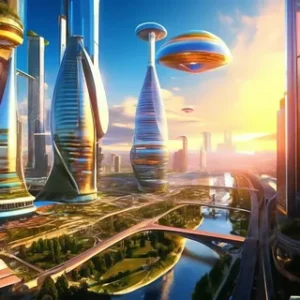
5. Space: Humanity’s Second Home
🚀 Colonies Beyond Earth
By future in 2100, humanity will no longer be Earth-bound. Mars will host several million inhabitants living in bio-domed cities. The Moon will serve as both a mining base and a launch hub for deeper space missions.
Asteroid mining will fuel the global economy, extracting rare minerals for quantum devices and fusion energy.
🛰️ Space Travel 2.0
Fusion propulsion and light-sail technology will allow travel to nearby exoplanets within decades. Generational ships — massive habitats traveling through deep space — may be en route to distant worlds by 2100.
The United Planetary Alliance (or similar body) could oversee space law, trade, and planetary ethics, ensuring colonization doesn’t repeat Earth’s mistakes.
👽 Contact and Cosmic Perspective
By 2100, the possibility of confirmed extraterrestrial contact will be high — not necessarily “aliens” as in movies, but microbial or intelligent signals from distant systems.
If humanity meets another intelligent species, it could redefine our identity, ethics, and religions forever.
6. Energy and the Environment: A Sustainable Future
☀️ Infinite Clean Power
Fossil fuels will be ancient history. The world will run on:
-
Fusion energy (miniature suns providing near-infinite power)
-
Solar orbital farms capturing sunlight directly in space
-
Geothermal megaplants tapping deep Earth energy
Energy will be so abundant that scarcity — the economic engine of past centuries — might vanish.
🔋 Energy as Currency
Instead of money, energy units or “quantum credits” might serve as the universal exchange system. Your energy footprint — how efficiently you live — could determine your social status.
🌊 Earth’s Healing
With sustainable energy, reforestation, and climate control satellites, Earth may finally begin to heal. Air will be cleaner, biodiversity restored, and cities integrated harmoniously with nature.
The scars of industrialization could give way to an age of eco-symbiosis — humanity not above nature, but part of it.
7. Governance and Global Unity
🏛️ From Nations to Networks
By future in 2100, traditional nation-states may dissolve into network-based governance systems — alliances of people bound by values and digital identity rather than geography.
Citizenship could become fluid: one might belong to multiple digital nations or “cloud societies.” Blockchain-based voting will ensure transparent democracy.
🌐 The Global Charter
After centuries of conflict, humanity may finally unite under a Global Charter of Rights and Responsibilities, balancing freedom, equity, and sustainability. AI judges could ensure fairness without bias or corruption.
But unity won’t come without resistance — regional identities, ideologies, and traditions will still shape cultural diversity, making Earth in 2100 a rich mosaic of beliefs and ways of life.
8. Art, Culture, and Human Spirit in 2100
Even in a hyper-technological future, art will thrive — perhaps more than ever.
Musicians might compose symphonies in collaboration with AI. Painters could use neural brushes that translate emotions into colors. Writers might craft stories that evolve dynamically with each reader.
Culture will be immersive, participatory, and deeply emotional. The arts will remind humanity of its soul — something machines, however intelligent, can only simulate but never truly feel.
Religions will also evolve — some embracing technology as divine creation, others focusing on spiritual simplicity amid digital chaos.
9. Challenges of the Future
The world of future in 2100 won’t be perfect. Humanity will face new dilemmas:
-
Privacy vs. transparency — how much of our lives should AI know?
-
Equality vs. enhancement — will genetic or neural upgrades create a new elite?
-
Virtual addiction — will people abandon the physical world for perfect digital realms?
-
Identity crisis — what does it mean to be human when consciousness can exist without a body?
How we answer these questions will define not just our technology, but our civilization’s soul.
10. Conclusion: A Choice Between Progress and Wisdom
The future in 2100 isn’t set in stone. It will be shaped by every decision humanity makes between now and then — in politics, technology, ethics, and compassion.
If we use our intelligence wisely, 2100 could mark the dawn of a golden age — a time when war, disease, and poverty are replaced by creativity, exploration, and harmony. But if we let greed and division rule, it could also be an age of digital feudalism and ecological collapse.
Ultimately, the world of 2100 will reflect not just our inventions, but our values.
Because the real future doesn’t depend on machines — it depends on us. 🌌