Abdul haye
1. Introduction: The Next Generation on the Horizon
Ever since the launch of the PlayStation 5 in 2020, gamers and industry watchers have been speculating: when will the next PlayStation — the PlayStation 6 (PS6) — arrive? With each passing year, the hardware inside the PS5 is stretched further by evolving game demands. New techniques like ray tracing, higher frame rates, and AI-assisted rendering push current consoles closer to their limits. Sony and AMD have already revealed glimpses of next-generation tech, hinting that the PS6 might really be approaching. Yet the landscape is complex: costs, performance, backward compatibility, and market competition all play huge roles in shaping the next console.
In this article, I’ll walk you through what’s known so far about PS6 (from official teases, leaks, and industry analysis), what we might reasonably expect in terms of features and performance, the challenges Sony faces, and how likely various scenarios are. Let’s dig in.
2. Historical Console Cycles: What the Past Tells Us
To project when PS6 might arrive, it’s useful to look at Sony’s historical cycles:
-
PlayStation (PS1) launched in 1994
-
PlayStation 2 arrived in 2000 (6 years later)
-
PlayStation 3 in 2006 (6 years later)
-
PlayStation 4 in 2013 (7 years later)
-
PlayStation 5 in 2020 (7 years later)
So far, Sony has generally followed a 6–7 year generational rhythm, though delays or shifts in strategy have occasionally adjusted that. The PS4 → PS5 cycle was 7 years, likely influenced by the sheer complexity and cost of newer hardware.
Given this pattern, a 2027 or 2028 launch for PS6 is in line with expectation — not too soon, but not unreasonably distant either. However, newer constraints (manufacturing costs, chip shortages, rising power / cooling demands) could stretch or shorten that window.
3. What We Know So Far: Official Teases & Statements
3.1 Mark Cerny & Project Amethyst
Recently, Sony and AMD unveiled a joint video centered around Project Amethyst — a collaborative effort exploring next-gen hardware innovations. In that, Mark Cerny, Sony’s lead architect, and AMD’s Jack Huynh discussed technologies like Neural Arrays, Radiance Cores, and Universal Compression.
Cerny said these features currently “exist in simulation” but he’s “really excited about bringing them to a future console in a few years’ time.” That’s not a direct PS6 announcement, but it strongly suggests that Sony is actively prototyping next-gen tech.
3.2 Sony’s “A Few Years” Remark
In the same discussions, Sony has repeatedly referred to the PS6 launch window as “a few years time.” That phrasing is vague — it could mean two years or five — but it sets expectations that PS6 is not imminent in 2025 but likely in the latter half of this decade.
Thus, while nothing is confirmed, Sony is preparing the groundwork publicly, suggesting that we should watch hardware reveals and partnerships (e.g., with AMD) for stronger hints.
4. Projected Release Window
4.1 Rumors Pointing to 2027
One of the strongest rumors is that PS6 will launch in 2027. Leakers such as KeplerL2 have claimed that manufacturing and internal plans are targeting that window, stating: “it’s the plan unless any unexpected delays occur.”
Push Square, a PlayStation-focused outlet, also cites that speculation, noting that Cerny’s “a few years time” aligns with a 2027 launch.
4.2 Possibility of 2028 or Delays
Because hardware development is inherently risky (supply chain issues, yield problems, cost escalation), a late 2027 or early 2028 release remains plausible. Some leaks assert that 2028 is still on the table.
If delays happen, the launch might slip further — though Sony likely hopes to avoid major setbacks.
Verdict (as of now): 2027–2028 is the most likely window for PS6, with 2027 seen by many as the “target year.” But take any specific date with caution — until Sony confirms, it’s all speculative.
5. Speculated Hardware & Architecture
Here’s where things get exciting. Based on the Project Amethyst disclosures and leaks, here’s what PS6 might bring under the hood:
5.1 CPU / GPU Direction
-
AMD-based SoC: Sony is expected to continue the partnership with AMD. Some coverage suggests Sony may have chosen its PS6 chip design as early as 2022, in part to maintain backward compatibility.
-
Zen-derived CPU cores: The CPU may advance to newer generational architecture (e.g. Zen 6 or beyond), with higher efficiency and better single-thread performance.
-
RDNA 5 GPU cores: The GPU likely evolves to RDNA 5 or a variant thereof, with enhanced ray tracing, path tracing, and compute capabilities.
-
Chiplet / modular design: There’s speculation that Sony may adopt a chiplet-based architecture (where CPU, GPU, memory, I/O are modular), which could improve yield and flexibility. Some leaks mention AMD chiplet designs.
5.2 Memory & Bandwidth Innovations
-
GDDR7 or advanced memory: To keep up with faster graphics and compression techniques, PS6 could use next-gen memory with higher throughput and efficiency.
-
Wider bus or smarter compression: While a wider memory bus increases cost and power, the rumored Universal Compression feature (discussed later) could reduce memory bandwidth stress and allow a more cost-efficient bus width.
-
Efficient memory architecture: The overall design likely balances memory speed, capacity, and compression more aggressively than current consoles.
5.3 Ray Tracing, Path Tracing & Neural Arrays
-
Radiance Cores: One of the headline features from Project Amethyst is the presence of dedicated Radiance Cores — hardware units intended to offload ray tracing and path tracing workloads, relieving the main GPU compute units from heavy lighting calculations.
-
Neural Arrays: Another key idea is using Neural Arrays — essentially letting GPU compute units share data more directly (like a collective AI engine). That can help with tasks like upscaling, denoising, and reconstructing scene details more efficiently. PlayStation LifeStyle+3TechRadar+3Tom’s Guide+3
-
Smarter upscaling / denoising: These AI / neural techniques may allow higher resolution visuals without full native rendering overhead, making features like 4K 120 FPS more feasible.
5.4 Universal Compression & Bandwidth Tricks
-
Universal Compression is a technique being explored in Project Amethyst that would compress not just textures, but more types of GPU data, to reduce memory bandwidth demands. This allows the GPU to push higher fidelity without needing exponentially more raw memory throughput.
-
Combined with Radiance Cores and Neural Arrays, the synergy might let PS6 extract more performance from available hardware, especially under power and thermal constraints.
6. Backward Compatibility & Ecosystem
6.1 PS5 / PS4 Game Support
One big question is whether PS6 will support PS5 and PS4 games. Sony has shown interest in backward compatibility in recent generations (e.g. PS5 supports many PS4 titles). Many expect PS6 to continue this trend — likely emulating or natively supporting PS5 and PS4 libraries — though support for PS3, PS2, and PS1 titles is less certain.
Continuity is important: allowing existing users to bring their libraries forward helps adoption and goodwill.
6.2 Game Streaming & Cloud Integration
While local hardware tends to deliver the best performance, cloud gaming is becoming more viable. Sony already has interest in cloud and streaming platforms. But Sony’s leadership has also emphasized that internet stability, latency, and infrastructure are not fully under their control, so they still see native hardware as essential.
Therefore, PS6 might feature stronger integration with cloud services (e.g. hybrid streaming + local rendering fallback), but it’s unlikely to lean entirely cloud-based.
7. Design & Form Factor Possibilities
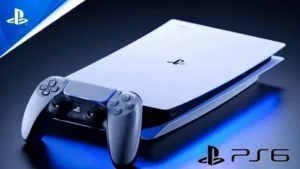
7.1 Digital vs Disc Versions
There’s speculation that PS6 will come in two versions:
-
A disc (physical media) version, with a detachable or modular disc drive
-
A digital-only version, without a drive
-
Users might be able to buy the drive later and attach it to a digital console.
This mirrors the PS5 Slim’s approach to detachable drive designs and helps with manufacturing and shipping cost efficiencies.
7.2 Removable Drive Rumors
Some reports claim the disc drive will be detachable or optional — meaning the console’s base unit might exclude the drive to reduce cost, weight, and complexity.
7.3 Cooling, Size & Modularity
-
Better cooling: Given higher performance and power density, PS6 will likely require improved cooling solutions (liquid cooling, vapor chambers, larger heatsinks).
-
Modular or serviceable parts: To improve longevity, Sony might adopt more modular components (e.g., replaceable SSDs, cooling modules, expansion slots).
-
Compact or efficient chassis: Sony may aim for a sleeker, more efficient physical design to reduce weight and shipping costs (as seen in PS5 Slim trends).
8. Performance Targets & Game Experience
8.1 4K / 120 FPS Aspirations
One of the expected goals for PS6 is to make 4K at 120 frames per second (or better) more commonplace. While current-gen consoles sometimes struggle to maintain high frame rates in graphically intense scenes, PS6’s hardware upgrades (Neural Arrays, Radiance Cores, better compression) might make that smoother.
8.2 VR, AR & Mixed Reality
Given Sony’s investment in VR (e.g. PS VR2), PS6 could push further into virtual reality or mixed reality support:
-
Higher resolution VR experiences
-
Lower latency, higher refresh rates
-
Better GPU / compute sharing for mixed-reality blending
-
Possibly modular VR adaptation
While AR / MR is less certain (since console is traditionally display-centric), PS6 might provide APIs or hardware hooks to support AR accessories in the future.
8.3 AI, Physics & World Simulation
With stronger compute and neural techniques, PS6 games may feature:
-
Smarter NPC AI
-
More realistic physics (cloth, water, destructibles)
-
World-scale simulations (weather, ecosystems)
-
Procedural generation with quality on par with handcrafted content
These enhancements could make game worlds feel more alive and responsive.
9. Software & Developer Considerations
9.1 Tools, SDKs & Engine Support
For PS6 to succeed, Sony must provide strong developer tools, robust SDKs, debugging, profiling, and support for common game engines (Unreal, Unity, etc.). The use of Neural Arrays, Radiance Cores, and compression techniques will require new APIs and pipelines, so adoption by developers is critical.
9.2 Porting & Asset Reuse
To ease transition, Sony may emphasize compatibility layers or conversion tools so that PS5/PS4 games can be ported more easily. Asset reuse can reduce development burden. Developers will likely need guidelines on how to leverage new PS6 features (e.g. when to offload to Radiance Cores vs compute units).
10. Challenges & Bottlenecks
10.1 Thermal, Power & Cost Constraints
-
High performance typically means high power draw and heat output. Managing that efficiently will be a major design constraint.
-
More advanced silicon (e.g. 3nm nodes) may reduce power demands, but cost and manufacturing complexity rise.
-
The cost of components (memory, GPU cores, cooling) must be balanced to hit a consumer-friendly price point.
10.2 Manufacturing & Supply Chain Risks
Chip shortages, wafer yield issues, or supply chain disruptions (e.g. with rare materials) could delay plans. Sony will have to secure strong manufacturing partnerships and manage risk aggressively.
10.3 Diminishing Returns & “Good Enough” Hardware
As consoles become more powerful, the leap between generations can feel smaller to consumers. If PS6 improvements are too incremental, many users may skip upgrading. Sony needs to ensure that the performance / experience difference is compelling.
11. Competitive Context: Xbox, PC & Cloud
11.1 Microsoft / Xbox Strategy
Microsoft is Sony’s chief competitor. If Xbox launches a new console or hybrid PC-console device soon, Sony must match or exceed it in key features — in GPU power, services, backward compatibility, and ecosystem strength.
11.2 PC Gaming as a Rival
High-end PCs already exceed console hardware in many areas. Sony must offer strong value (exclusive games, optimized performance, ease-of-use) to differentiate from PC gaming options.
11.3 Role of Cloud Gaming
Cloud gaming (e.g., via PlayStation Now / cloud streaming, or rivals like Google Stadia, Xbox Cloud) will pressure consoles to be more adaptive. A hybrid approach (local + streaming fallback) might become the norm. Sony needs strong networking, low-latency infrastructure, and partnerships.
12. What Sony Needs to Get Right
12.1 Balanced Specs vs Price
Even the most powerful console fails if it’s too expensive or overpriced relative to perceived value. Sony must choose a hardware spec that’s compelling but not cost-prohibitive.
12.2 Strong First-Party Titles
The power of a console often lies in its exclusive games. Ensuring first-party studios have the tools, budget, and creative freedom is essential to drive uptake.
12.3 Seamless Backward & Forward Compatibility
Ensuring that users can bring their game libraries and enjoy upgrades (e.g. “enhanced versions” on PS6) will encourage adoption and goodwill.
12.4 Developer Ecosystem & Support
Attracting third-party and indie studios is critical. Good tools, documentation, revenue sharing, and support are important.
13. How We Should Approach Rumors: Skepticism vs Hype
Given how often leaks or speculations shift, it’s important to approach these rumors with caution:
-
Many early leaks never materialize in final hardware
-
Plans may change mid-development due to cost / yield / market shifts
-
Corporate messaging (“a few years”) is deliberately vague
-
Always wait for official announcements before making assumptions
Our job is to read between lines, track credible leaks, and note patterns — but accept uncertainty until Sony confirms.
14. Best-Case & Worst-Case Scenarios
14.1 Best-Case: A True Generational Leap
-
PS6 launches in late 2027 at a competitive price
-
Offers 4K 120 FPS in many games, robust ray / path tracing
-
Smooth backward compatibility and seamless library migration
-
Strong first-party launch lineup, developer momentum
-
Modular design, optional drive, good cooling and reliability
14.2 Modest Upgrade / Incremental
-
PS6 offers modest improvements over PS5 Pro rather than a revolution
-
Some games may still be optimized for PS5, not fully leveraging new features
-
Some features (like Radiance Cores) are supported but not fully utilized
-
The console is solid but not “must upgrade” for many users
14.3 Delayed or Troubled Launch
-
Launch delays push release to 2028 or beyond
-
Hardware yields / costs cause compromises in specs
-
Lackluster adoption if price is too high or exclusive titles are weak
-
Negative comparisons to Xbox or PC
Among these, the incremental and best-case scenarios seem most likely, unless serious missteps occur.
15. Conclusion & What to Watch Next
At this point, PS6 is still under wraps — not officially confirmed, but heavily teased via Project Amethyst and evolving hardware research. The strongest rumors place its launch in 2027, possibly slipping into early 2028. On paper, its architecture may include Neural Arrays, Radiance Cores, and Universal Compression — all aiming to push graphical fidelity, efficiency, and smart rendering forward.
But hardware is only part of the puzzle. For PS6 to succeed, Sony must balance cost and performance, offer compelling exclusives, support backward compatibility, and build robust developer tools. It also must face competitive pressure from Microsoft, the PC space, and the emerging cloud gaming market.
Over the coming months and years, key signs to watch:
-
Any official Sony or AMD reveal of a console or dev kit
-
Partnerships or leaks about new GPU / chip architecture
-
Statements by Sony executives about generational cycles or console strategy
-
First-party game announcements tied to “next-gen hardware”
-
Leaks from manufacturing / supply chain sources
Once some of those pieces fall into place, we’ll get firmer clarity. Until then, enjoy the speculation — and the PS5’s lifespan.
FAQs
Q1: Has Sony officially confirmed the PS6 launch date?
No. Sony has not yet confirmed a release date or full details. What we have are teases and statements suggesting “a few years away.”
Q2: Is it certain that PS6 will support PS5 games?
While it’s not guaranteed, backward compatibility is widely expected — at least for PS5 and possibly PS4 — given Sony’s past commitment to game preservation.
Q3: What is Project Amethyst, and why is it important?
Project Amethyst is a joint Sony–AMD R&D initiative focused on next-generation graphics and AI innovations (e.g. Neural Arrays, Radiance Cores, Universal Compression). It’s believed to form the foundation of PS6’s hardware capabilities.
Q4: Will PS6 come in a disc and digital version?
Yes, that is a leading rumor. Reports suggest a detachable disc drive option, with a base digital model and a version bundled with or capable of adding a disc drive.
Q5: Could the PS6 launch be delayed?
Absolutely. Manufacturing, yield, supply chains, costs, or shifting market conditions could all push the timeline beyond 2027 or alter specs.