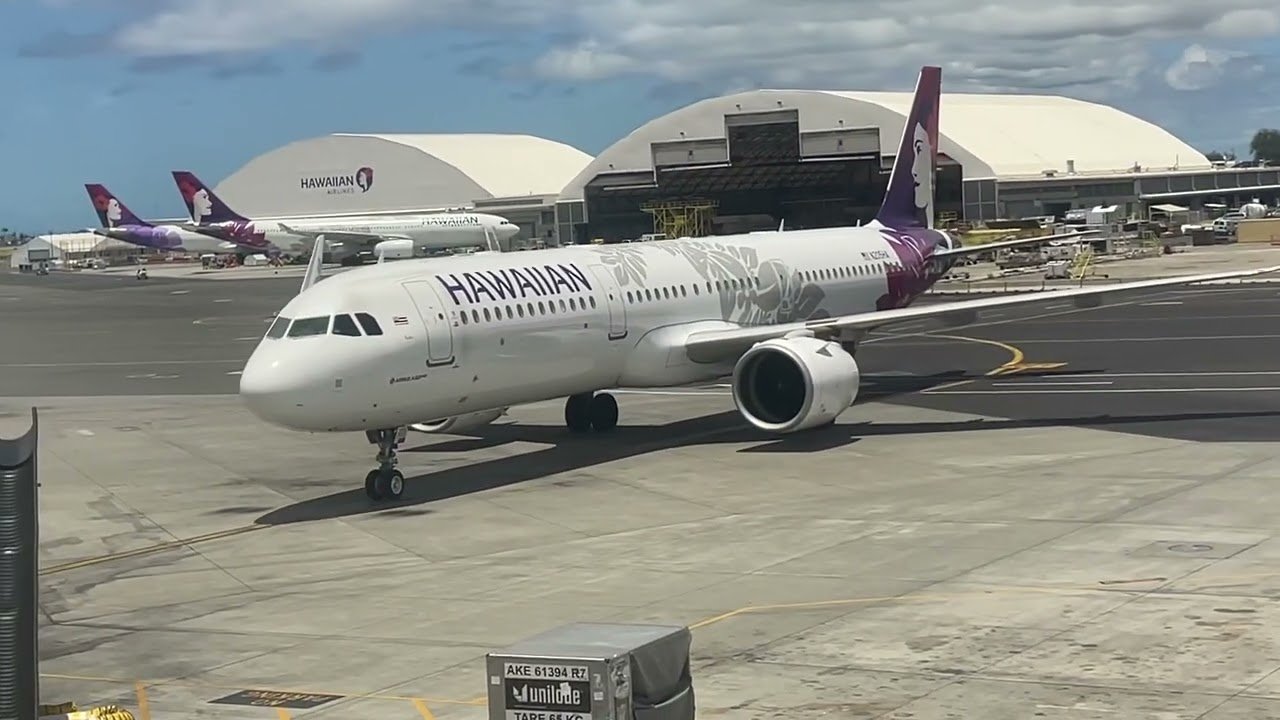
Few things rattle a traveler’s nerves quite like a mid-flight emergency over the open ocean. For passengers aboard Hawaiian Airlines Flight 59 on August 11, 2025, that scenario became very real — and it shone a spotlight on a series of mechanical challenges that have followed the airline’s Airbus A321neo fleet for years. From a dramatic Pacific U-turn to a sweeping Pratt & Whitney engine recall, here is a complete look at the Hawaiian Airlines A321neo mechanical issue, what caused them, and what the airline has done to keep passengers safe.
The August 2025 Incident: A U-Turn Over the Pacific
On the morning of August 11, 2025, Hawaiian Airlines Flight 59 departed Sacramento International Airport (SMF) bound for Maui. The aircraft — an Airbus A321neo — never made it. Midway across the vast Pacific Ocean, the flight crew detected a mechanical fault that left them with no safe option but to turn back.
The root cause was a failure of the aircraft’s backup air-conditioning unit. This may sound like a minor comfort issue, but it is far more serious than that. The backup air-conditioning system is a required piece of equipment for any aircraft operating beyond a three-hour radius from an airfield. Over the Pacific, where the nearest diversion airport can be hundreds of miles away, losing that system is a genuine safety concern.
The pilot declared an emergency with air traffic control immediately upon discovering the fault. Thanks to that swift action, air traffic control was able to prioritize the flight’s course changes, and the aircraft landed safely at Oakland International Airport (OAK) — nearly four hours after it had originally departed Sacramento. All 191 passengers and crew aboard arrived safely on solid ground.
Hawaiian Airlines’ response to the diversion was comprehensive. The airline worked quickly to rebook affected passengers, provided hotel accommodations where needed, and communicated transparently with travelers throughout the disruption. While the incident caused significant delays and disrupted travel plans, the outcome underscored a fundamental truth about modern aviation: safety protocols, when followed correctly, work.
The Bigger Picture: Pratt & Whitney Engine Recall
The August 2025 incident was not the first time the Hawaiian Airlines A321neo fleet made headlines for mechanical problems. Beginning in mid-2023, the airline became entangled in one of the most disruptive engine crises in recent U.S. aviation history.
In July 2023, Pratt & Whitney informed Hawaiian Airlines — at the last minute, just before the airline’s own quarterly earnings call — that some of the Airbus A321neo engines powering its fleet would need to be removed and returned for inspection and possible repair. The engines in question were the PW1100G Geared Turbofan (GTF) engines, and the problem stemmed from a rare condition in the powdered metal used to manufacture certain high-pressure turbine disk components. This manufacturing flaw created the risk of microscopic cracks forming, which could potentially lead to premature component failure.
RTX, Pratt & Whitney’s parent company, announced that roughly 1,200 PW1100G engines on A320neo-family aircraft built between 2015 and 2021 needed to be removed and inspected within 12 months. Every single one of Hawaiian Airlines’ 18 A321neos fell within that production window, making the carrier one of the most exposed airlines in the United States.
What made the situation dramatically worse was the timeline for repairs. Initially, Pratt & Whitney estimated that inspections would take around 60 days per engine. That estimate ballooned to as many as 300 days per engine — five times longer than originally projected. RTX also took a $3 billion financial charge as a result of the crisis, and its stock hit a multi-year low. Across all affected airlines globally, an average of 350 jets were projected to be grounded per year through 2026, with as many as 650 aircraft sitting idle in the first half of 2024 alone.
How Hawaiian Airlines Was Impacted
For Hawaiian Airlines, the engine crisis hit especially hard. The A321neo fleet plays a critical role in the carrier’s network, operating West Coast-to-Hawaii routes that are too long for its smaller Boeing 717s but do not require the wide-body capacity of its Airbus A330s or Boeing 787-9 Dreamliners. With those 18 narrowbody jets effectively forming the backbone of its mainland-Hawaii service, losing even a handful of aircraft created serious operational strain.
The airline was forced to suspend multiple routes, including pausing Lihue-Oakland service from September through mid-December 2023, and suspending Honolulu-San Jose and Kahului-San Jose flights through January 2024. The Kahului-Las Vegas route was also temporarily halted. Hawaiian’s A321neo capacity in November 2023 was nearly 10% lower compared to the same period the prior year.
The financial toll was significant. Hawaiian Airlines reported an operating loss of $9.6 million in the second quarter of 2023, and the engine problems continued to pressure results into subsequent quarters. The airline had to extend leases on its older A330 widebody aircraft to maintain its network and mitigate the A321neo capacity shortfall. Hawaiian CEO Peter Ingram described the situation as “frustrating,” noting that the airline had been “living a little bit too close to the razor’s edge” in terms of operational resilience.
Pratt & Whitney did ultimately provide Hawaiian with maintenance credits to offset some of the financial damage caused by engine unavailability. However, the disruption to passengers, schedules, and revenue was substantial and lasted well into 2024.
The A321neo: A Capable Aircraft Caught in a Wider Crisis
It is worth emphasizing that the Airbus A321neo itself is widely regarded as one of the most capable and efficient narrowbody aircraft in commercial aviation. The aircraft offers a longer range and lower fuel burn than many of its competitors, making it particularly well-suited for trans-oceanic routes like those Hawaiian Airlines operates between the U.S. West Coast and the Hawaiian Islands. Hawaiian’s A321neos also feature free Starlink internet, USB charging ports, and mood lighting, with the aircraft’s quiet engines contributing to a premium passenger experience.
The mechanical issues that plagued the fleet were not a reflection of the airframe’s design, but rather a manufacturing defect in the Pratt & Whitney engines that power it — a problem that affected hundreds of aircraft across dozens of airlines worldwide, from JetBlue and Spirit in the United States to Wizz Air in Europe and ANA in Japan.
Hawaiian Airlines currently operates 18 of the Airbus single-aisle jets, with an average age of just over six years. The airline uses these aircraft primarily on routes from the West Coast of the U.S. to the Hawaiian Islands, filling the critical mid-range gap in its fleet between its widebody international jets and its interisland 717s.
Safety First: What the Incidents Tell Us
Both the 2025 backup air-conditioning failure and the broader Pratt & Whitney engine crisis reveal something important about how modern airlines manage mechanical risk. In the case of Flight 59, the pilot’s immediate declaration of an emergency and the swift coordination with air traffic control ensured that all 191 people on board returned safely to the ground. The aircraft’s advanced monitoring systems detected the fault promptly, allowing the crew to respond before the situation escalated.
In the case of the engine recall, Hawaiian Airlines moved quickly once informed, proactively announcing schedule changes the very next day and working with Pratt & Whitney to minimize disruption. While no airline wants to ground aircraft or cancel flights, the willingness to do so — rather than push the limits of operational safety — reflects the industry’s core commitment to passenger protection.
For travelers planning a trip to Hawaii on Hawaiian Airlines, the good news is that the Pratt & Whitney engine repairs have since been completed across the fleet. With the airline now operating as part of the Alaska Airlines family following their merger, additional resources and infrastructure are in place to support reliable A321neo service going forward.
Final Thoughts
The Hawaiian Airlines A321neo mechanical issues — from the dramatic mid-Pacific U-turn of Flight 59 to the sweeping Pratt & Whitney engine recall — tell a story of an airline navigating serious external challenges while keeping passenger safety at the forefront. The incidents caused real disruption and financial pain, but they also demonstrated that aviation’s layered safety systems, when properly followed, do what they are designed to do: keep people safe, even when things go wrong at 35,000 feet over the Pacific Ocean.