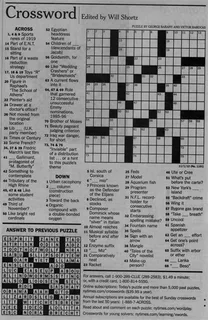
It started with eleven empty boxes and a single question: Futures experts?
If you were working through the New York Times crossword puzzle on August 7, 2025, you likely paused at that clue. Your mind probably jumped to Wall Street — commodities traders, financial analysts, market forecasters. None of them fit. The answer, as thousands of solvers eventually discovered, was SOOTHSAYERS.
Fortune tellers. Palm readers. The people who claim to see tomorrow before it arrives.
The brilliance of that NYT clue lies in its misdirection. “Futures” is a word we’ve handed over almost entirely to finance. We talk about futures markets, futures contracts, and futures trading as though the word belongs exclusively to economics. But the clue reminded us of something important: the original futures experts were never on Wall Street. They were reading tea leaves and crystal balls long before there were Bloomberg terminals.
That pivot — from the financial to the philosophical, from the transactional to the visionary — is exactly where the modern field of futures studies lives today. And in 2026, the work of real-world futures experts has never been more urgent, more complex, or more consequential.
What Is a Futures Expert, Really?
A futures expert — or futurist — is not a fortune teller in the mystical sense. But the NYT crossword clue wasn’t entirely wrong, either. Both soothsayers and modern futurists are in the business of anticipating what comes next, of reading patterns in the present to illuminate the shape of things to come.
Functioning beyond headlines, futures analysis studies patterns of change across decades, anticipating cascading vulnerabilities across systems — financial, environmental, digital, and sociopolitical. It is a discipline that sits at the intersection of data science, systems thinking, sociology, and strategic planning.
Where a financial analyst might forecast next quarter’s earnings, a futures expert asks: What will the global economy look like in 2040? How will climate change reshape migration patterns? What happens when artificial intelligence becomes more capable than the humans who built it?
These are not abstract questions. They are the questions that governments, corporations, and international institutions are paying serious money to answer — and the answers are growing more alarming by the year.
The Predictions That Are Too Big for the Evening News
One of the most striking observations coming from the futures research community in 2026 is the gap between what experts are modeling and what the public actually hears. Veteran futures analysts warn of economic, technological, and geopolitical disruptions that will drastically reshape global stability — yet mainstream media, driven by the demands of immediacy and drama, struggles to give these long-horizon threats the sustained attention they deserve.
“Television thrives on the immediate and the dramatic,” notes one lead futures strategist. The problem is that the most consequential risks are neither immediate nor dramatic in the traditional sense. They are slow-moving, interconnected, and deeply systemic — which makes them almost impossible to fit into a 30-second news slot, even as their potential impact dwarfs any single headline event.
The result is a dangerous dissonance between what is being broadcast and what is actually unfolding. Public unawareness of these unspoken futures has tangible consequences: financial instability, food supply chain disruptions, and climate migration will not surprise those who have heard the forecasts — yet their absence from mainstream discourse delays both individual and societal preparation.
The Convergence of Crises: What Futures Experts Are Actually Warning About
So what are the futures experts seeing? According to recent analysis from leading forecasters, a convergence of systemic risks is creating scenarios so extreme they challenge conventional risk modeling. These risks do not operate in isolation — they interact, amplify, and cascade in ways that make the sum far more dangerous than any individual part.
Climate Tipping Points
Climate scientists and futures analysts are increasingly aligned on one sobering conclusion: we are approaching thresholds where climate change becomes self-sustaining. Massive permafrost thaw releasing stored methane, disruption of Atlantic Ocean currents, and widespread ecosystem die-offs are no longer distant possibilities. They are projections grounded in sovereign climate models updated with real-time satellite data. Once crossed, these tipping points do not reverse on human timescales.
Technological Disruption
While artificial intelligence accelerates innovation at an unprecedented pace, futures experts now highlight its unmitigated risks with equal urgency. Runaway algorithmic decision-making in financial markets, autonomous cyberattacks, and the erosion of public trust in critical infrastructure could trigger cascading failures that no single institution is equipped to contain.
“AI systems are growing too complex to fully govern,” warns one chief futurist. “A single misaligned model update can ripple across global markets.” The concern is not science fiction — it is an extrapolation of trends already visible in today’s interconnected digital infrastructure.
Geopolitical Fragmentation
The post-2020 era of fluid alliances is hardening into rigid geopolitical blocs. Trade dependencies that once seemed like the architecture of global stability are now being recognized as vulnerabilities. Supply chain disruptions, manufacturing delays, and the weaponization of economic interdependence are reshaping how nations relate to one another — and the forecast is not encouraging.
From Worst-Case Scenario to Execution Risk
Perhaps the most significant conceptual shift in futures analysis over the past decade is the reclassification of worst-case scenarios. Traditionally, catastrophic outcomes were treated as outliers — rare, theoretical, and too distant to warrant immediate action. Today’s futures experts are reframing them as plausible execution risks, grounded in converging trends and predictive modeling.
The probability of cascading collapse is rising, not because a single catastrophic event is imminent, but because the sum of fragile, interacting systems is approaching a tipping point. A cyberattack on a power grid, a major AI malfunction in trading algorithms, a geopolitical flashpoint that disrupts critical supply lines — any one of these might be manageable in isolation. Together, they create a scenario where financial contagion spreads, credit freezes halt investment, public trust collapses, and climate thresholds are crossed simultaneously.
This is not doom-mongering. It is systems thinking applied to global risk — and it demands a response.
What Futures Experts Say We Should Do
The good news is that futures analysis is not only about identifying threats. It is equally about identifying leverage points — the places where early, targeted action can prevent catastrophic outcomes or at least build the resilience needed to survive them.
Futures experts advocate for investing in early-warning systems powered by AI and big data, strengthening cross-border cooperation, and decentralizing critical infrastructure so that no single point of failure can bring down entire systems. Businesses are urged to embrace scenario-based risk planning, moving beyond compliance frameworks to genuinely anticipate systemic failure. And social cohesion — transparent communication, inclusive economic policies, and community-level resilience — is identified as a vital buffer against the kind of institutional collapse that makes crises unmanageable.
“Preparedness is not about eliminating risk — it’s about surviving unpredictability,” as one lead futures analyst put it. The goal is not to predict the future with certainty. It is to expand the range of futures we are prepared for.
The Soothsayers Were Right About One Thing
Back to those eleven empty boxes. The NYT crossword clue was playful, even subversive — a reminder that our obsession with financial futures has blinded us to other kinds of foresight. The soothsayers of antiquity were not always right. But they served a function: they forced their communities to look ahead, to take the future seriously as something that could be shaped rather than simply endured.
Modern futures experts serve the same function, armed with data models instead of crystal balls. The NYT crossword clue “Futures experts?” and its answer SOOTHSAYERS is, in its own small way, a perfect encapsulation of what the field is all about — the ancient, deeply human insistence on trying to see what is coming before it arrives.
The difference today is that the stakes have never been higher, the tools have never been more sophisticated, and the warnings have never been clearer. The question is whether the rest of us are listening.