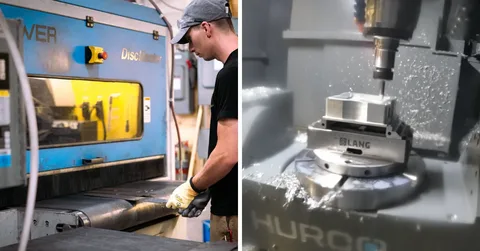
The CNC manufacturing industry is undergoing one of the most transformative periods in its history. Driven by rapid advancements in artificial intelligence, automation, sustainability, and digital integration, the sector is evolving at a pace that is reshaping how businesses approach production, efficiency, and growth. According to the latest report from Fortune Business Insights, the worldwide CNC machine tool market is projected to surpass $110 billion in 2026, with a compound annual growth rate of approximately 7%. This growth reflects not only the widespread adoption of CNC technology but also the emergence of more efficient and intelligent production models as the new industry standard.
For manufacturers, shop owners, and CNC operators, staying current with CNC manufacturing news is no longer optional — it is a competitive necessity. This guide breaks down the most important developments and trends defining the CNC manufacturing landscape in 2026.
1. AI Integration: From Tool Wear Detection to Conversational Machining
Artificial intelligence is arguably the most significant force reshaping CNC manufacturing news today. While AI adoption in machining remains practical and early-stage for many shops — focused on tool-wear detection, predictive maintenance, and cutting-parameter recommendations — the technology is already delivering measurable results across the industry.
One of the most striking recent developments comes from Japan, where a $15 billion precision manufacturing industry is adopting AI solutions to stay competitive amid a persistent and widening workforce gap. Japanese manufacturing firm ARUM Inc. has introduced a conversational AI system called KAYA, which guides operators through machining tasks using natural language instructions. Built on proprietary software ARUMCODE and Microsoft Azure AI tools, the system translates traditional craftsmanship into automated workflows — meaning tasks once handled by skilled machinists can now be performed by junior workers. Programming a precision component that previously took over an hour can now be completed in minutes, delivering efficiency gains that are particularly valuable for high-mix, low-volume manufacturing where speed and cost control are critical.
At the enterprise level, German machine tool leader DMG Mori launched its new CELOS X production management platform in 2026. This AI-powered system monitors production in real time, automatically optimizes machining parameters, and provides early warnings for equipment failures. Expected to set a new industry standard, CELOS X is helping manufacturers worldwide achieve more efficient, data-driven operations.
2. Automation Expands Beyond the Machine: Lights-Out Manufacturing Becomes Reality
Automation continues to dominate CNC manufacturing news, with more affordable and user-friendly automated solutions making high-volume production accessible to businesses of all sizes. In 2026, automated CNC production lines are no longer just for large industrial plants — they are being tailored for small shops and custom manufacturers.
The most significant shift is that shops are applying automation to surrounding steps, not just machine tending. Robot-tended CNC cells, automated pallet changers, self-calibrating tool presetters, and automated inspection processes are becoming the norm. The goal is lights-out machining: continuous, unmanned production supported by smart scheduling and remote monitoring. Driven by labor shortages, geopolitical risks, and logistics disruptions that have accelerated reshoring, manufacturers are investing heavily in automation to offset higher labor costs while maintaining quality and throughput.
Importantly, this new wave of automation is less about replacing workers and more about amplifying skilled labor — letting one technician oversee several machines, interpret analytics, and manage exceptions rather than performing repetitive loading tasks. Automation is increasingly tied to quality and delivery reliability, not just throughput.
3. Digital Twin Technology Matures Into Living Production Ecosystems
Digital twin technology — once a buzzword for simulation — is maturing into one of the most powerful tools in CNC manufacturing. In 2026, digital twin integration is becoming standard for new CNC machines, and the technology has evolved far beyond simple toolpath visualization.
The 2026 digital twin integrates design, process engineering, machining, and inspection into a continuously updated model. Virtual commissioning, clash detection, and kinematic validation are now done long before the first chip is cut — reducing setup time, preventing costly errors, and shortening lead times. Factories are also pairing digital twins with mixed-reality tools, enabling virtual training and remote support that improves collaboration across teams and reduces reliance on a shrinking pool of expert operators.
The digital twin’s true power lies in its feedback loop: real machining data continuously refines simulation accuracy, making each production cycle smarter than the last. For manufacturers dealing with complex parts and tight deadlines, this capability is becoming indispensable.
4. Hybrid Manufacturing: Combining Additive and Subtractive in One Platform
Once seen as competing technologies, hybrid manufacturing — where a single platform combines metal deposition (additive) with CNC cutting (subtractive) — is gaining significant traction in 2026. This approach is particularly prominent in aerospace, energy, medical, and MRO (Maintenance, Repair and Operations) sectors.
Hybrid manufacturing solves two long-standing challenges simultaneously. On the material waste front, additive processes build near-net shapes while machining finishes critical features — dramatically reducing waste compared to purely subtractive methods. On the geometry front, hybrid systems enable internal channels, lattice structures, and conformal cooling paths that are impossible to cut conventionally. The result is a more efficient production model with fewer setups and shorter lead times.
Shops that master hybrid workflows early are positioning themselves for a significant competitive advantage as customers increasingly demand lighter, more efficient, and highly customized components.
5. Sustainability Becomes a Core KPI, Not a Corporate Afterthought
Sustainability is one of the most important trends in CNC machine tools news for 2026. Manufacturers worldwide face growing pressure to reduce their carbon footprint and adopt eco-friendly practices — and by 2026, sustainability is no longer sitting in corporate reports. It is embedded in machining KPIs.
Traditional machining methods, such as chemical rust removal and abrasive cleaning, are being replaced by sustainable alternatives. Laser cleaning machines eliminate rust, paint, and contaminants without chemicals or abrasives. Energy-efficient CNC machine tools are reducing power consumption by 30% or more. Nesting software maximizes material usage, cutting waste across wood, metal, and stone fabrication. Japanese manufacturer Makino has also introduced a CNC machining center specifically designed for electric vehicle motor housings, reflecting the growing intersection of green energy and precision manufacturing.
For manufacturers with ESG commitments and customers who increasingly demand sustainable supply chains, these developments represent both an obligation and a competitive differentiator.
6. Smart Factory Connectivity and Data-Driven Decision Making
The Internet of Things (IoT) and machine connectivity continue enabling “smart factory” environments where production and quality data move seamlessly between machines, Manufacturing Execution Systems (MES), and ERP platforms. This connectivity supports traceability, faster scheduling decisions, and real-time visibility into shop floor performance.
A major development in this space is the release of CAPPS 2026 by Applied Automation Technologies (AAT3D). This advanced CNC and metrology software suite delivers major enhancements in closed-loop process control, reporting, and multi-platform hardware support — enabling manufacturers to measure, analyze, and adapt directly on the machine tool. Built for production environments where precision and throughput are critical, CAPPS 2026 integrates dimensional metrology into CNC machining workflows, resulting in improved process control, reduced scrap, shorter cycle times, and greater confidence in part conformance across aerospace, medical, tooling, and high-precision manufacturing sectors.
7. 5-Axis Machining and Accessibility for Smaller Shops
Five-axis machining is becoming more common and competitive in 2026, primarily because it reduces setups and handling for complex parts. What was once reserved for large aerospace and defense contractors is now increasingly accessible to mid-sized and even small shops, thanks to more competitive pricing and improved ease of use.
At the same time, the rise of compact, affordable CNC machines is making precision manufacturing accessible to hobbyists, small shop owners, and startup businesses — democratizing CNC technology in a way that was unimaginable just a decade ago. Companies like Tormach are at the forefront of this movement, empowering creators, entrepreneurs, and educators with tools that deliver powerful manufacturing capabilities at accessible price points.
The Road Ahead: CNC Manufacturing in 2026 and Beyond
CNC machining in 2026 is defined by integration and insight. The industry is less about hype and more about resilience — shops are investing in internal training to stabilize capacity, expanding automation to improve throughput and quality, and adopting smarter connectivity for traceability and faster decisions.
In the coming years through 2035, the CNC manufacturing industry will continue its strong growth trajectory. With the widespread adoption of AI, automation, and green machining technologies, CNC manufacturing is heading toward a fully intelligent era. For companies seeking to stay competitive, seizing opportunities for technological innovation, investing in smart manufacturing equipment, and closely following emerging market demands will be the keys to long-term success.