Jeffrey Epstein, a financier and convicted sex offender, was found dead in his jail cell in August 2019. His death was ruled a suicide, but questions and conspiracy theories have swirled ever since, largely due to his connections to powerful figures and circumstances surrounding his incarceration. In the aftermath, every aspect of his personal records—including notes, letters, and signatures—has come under close examination.
Handwriting samples taken from Epstein’s prison records, personal journals, and legal documents are seen not just as mundane artifacts, but as crucial pieces of evidence. They play a role in verifying the authenticity of documents, examining the state of his mind in his final days, and even in the ongoing speculation about the manner of his death.
What Is a Handwriting Sample?
A handwriting sample is a portion of written text produced by an individual under normal circumstances. In forensic settings, handwriting samples are used for comparison and authentication. In Epstein’s case, handwriting samples include:
- Signatures on legal documents and financial forms
- Notes reportedly written in prison
- Journal entries and correspondence
These samples are valuable for both legal and psychological analysis. Forensic document examiners, also known as graphologists, compare handwriting samples to determine authenticity, detect forgeries, and draw conclusions about the person’s identity and mental state.
The Role of Handwriting in Legal Investigations
Handwriting analysis has been a tool for law enforcement and legal professionals for decades. In the Epstein case, handwriting samples have been used to:
- Authenticate documents such as wills, financial transfers, and personal notes
- Examine the authenticity of Epstein’s alleged suicide note
- Evaluate whether any documents may have been forged or altered
The analysis of Epstein’s handwriting is particularly relevant in the context of his will, signed just two days before his death. Questions about the legitimacy of this document—and whether Epstein was under duress or mentally competent—have made handwriting analysis an essential part of the investigation.
Graphology: What Can Handwriting Reveal?
Graphology, or handwriting analysis, is sometimes used to assess psychological traits or mental state. While not universally accepted in scientific or legal communities, graphology can offer some tentative insights. In Epstein’s case, analysts have looked for signs of stress, anxiety, depression, or even coercion in his final written communications.
Some characteristics that graphologists examine include:
- Pressure applied to paper
- Size and slant of letters
- Spacing between words and lines
- Consistency of signature
For instance, erratic pressure, inconsistent slant, or irregular spacing might be interpreted as signs of emotional distress. However, it’s important to note that such interpretations are subjective and not admissible as hard evidence in court.
The Epstein Suicide Note: Authentic or Forged?
One of the most controversial documents associated with Jeffrey Epstein’s death is the so-called suicide note reportedly found in his cell. The note, which references prison conditions and grievances, was analyzed by both authorities and independent experts.
Handwriting experts compared the note to known samples of Epstein’s writing and signature. While some concluded the handwriting matched, others raised suspicions due to unusual slant, pressure, and style. The debate over the note’s authenticity has fueled conspiracy theories and public skepticism about the official account of Epstein’s death.
Signatures and Legal Documents: Scrutiny and Doubt
Epstein’s signatures on key legal documents—most notably his will, signed just days before his death—have been subjected to forensic examination. Experts reviewed the style, pressure, and consistency of the signature compared to previous verified samples. While most official conclusions have stated the signatures match Epstein’s known handwriting, some skeptics remain unconvinced, pointing to subtle anomalies or the possibility of forgery.
These doubts are amplified by the high stakes involved: the distribution of Epstein’s vast estate, the protection of assets, and the potential for further legal action against his associates or beneficiaries.
What Can We Learn from Handwriting Analysis?
While handwriting samples can confirm or cast doubt on the authenticity of documents, their ability to reveal psychological truths is limited. In Epstein’s case, handwriting analysis has:
- Helped verify the legitimacy of legal documents
- Offered possible insight into his state of mind
- Added to the body of evidence reviewed in the broader investigation
However, it’s crucial to recognize the limits of graphology. While certain features can suggest emotional distress or unusual circumstances, they are not definitive proof of intent or mental state. For this reason, handwriting analysis is usually just one piece of a much larger investigative puzzle.
Public Fascination and Media Coverage
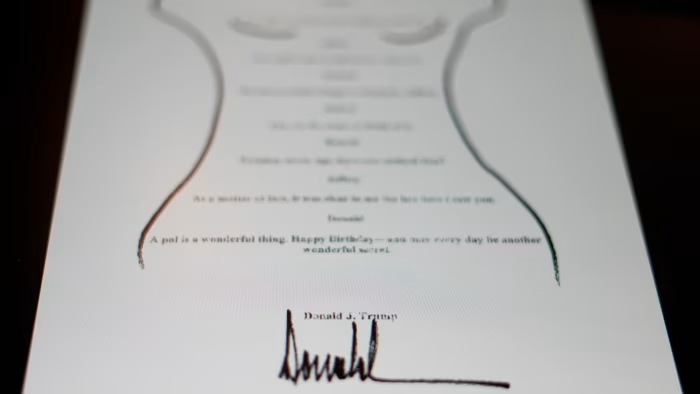
The enduring mystery and controversy surrounding Epstein’s death have made even his handwriting a subject of public fascination. Media outlets have published images of his notes and signatures, while online forums dissect every curve and slant of his penmanship for hidden meanings. This has contributed to an environment where even minor anomalies are interpreted as potential evidence of conspiracy or foul play.
Forensic Limitations and Ethical Considerations
It’s important to approach handwriting analysis with caution and skepticism. Forensic document examination is a specialized field, and conclusions are rarely black and white. There is always the possibility of error, bias, or misinterpretation. In high-profile cases like Epstein’s, the pressure to produce answers can sometimes lead to overreach or sensationalism.
Ethically, analysts must maintain objectivity and avoid drawing conclusions unsupported by evidence. In court, only qualified experts should offer testimony on handwriting, and their findings should be considered alongside other forensic and circumstantial evidence.
The Legacy of Epstein’s Handwriting Samples
As investigations and lawsuits related to Jeffrey Epstein continue, his handwriting samples remain part of the official record. They serve as a reminder of the many unanswered questions that still surround his life and death. For some, these samples are simply mundane artifacts; for others, they are tantalizing clues in an ongoing mystery.
Ultimately, the analysis of Epstein’s handwriting underscores the complexities of forensic investigation and public perception in high-profile cases. While handwriting can offer valuable insights and help authenticate documents, it is rarely the sole determinant of truth.
Conclusion: Handwriting as Evidence and Enigma
The scrutiny of Jeffrey Epstein’s handwriting samples reflects a broader fascination with his case and the desire for clarity in a story marked by secrecy and suspicion. While handwriting analysis has played a role in confirming document authenticity and exploring Epstein’s state of mind, it is only one thread in a tangled web of evidence.
As new information emerges and investigations continue, Epstein’s handwriting will likely remain a point of interest for forensic experts, journalists, and the public alike. Whether as evidence of authenticity, a window into his psyche, or a symbol of unresolved questions, these samples are now part of the enduring legacy of one of the most controversial figures of the 21st century.